Treatment journey
The Ponseti method: clubfoot treatment explained step by step
The Ponseti method is widely accepted as the standard treatment approach for idiopathic clubfoot. It is not a single procedure. It is a sequence: correction with serial casting, an Achilles tenotomy for many children when needed, and then bracing and follow-up to help maintain the correction.

Treatment at a glance
Ponseti treatment: what happens step by step
Gentle correction
A clinician trained in the Ponseti method gradually corrects the foot.
Serial long-leg casts
Each cast holds a new position. Cast changes are regular during correction, but the number of casts varies by child.
Bracing and maintenance
The prescribed foot-abduction brace helps maintain the correction.
Follow-up as your child grows
The clinical team continues to review the feet and brace through growth.
What the terms mean
What is the clinical team correcting?
Understand the four correction terms
- Cavus
- The high arch or twist through the middle of the foot is addressed first.
- Adductus
- The inward position of the front of the foot is gradually corrected.
- Varus
- The inward position of the heel is gradually corrected.
- Equinus
- The downward-pointing ankle position is addressed last.
These corrections require specific Ponseti technique and should only be performed by clinicians trained in the method. Parents should not try to manipulate the foot themselves.
Stage 1 — Serial casting
A clinician trained in the Ponseti technique gently manipulates the foot and applies an above-knee cast to hold the new position. The cast is changed repeatedly as correction progresses. The number of casts is not identical for every child.

Stage 2 — Achilles tenotomy, if needed
After the main parts of the deformity have been corrected, many babies still have tightness at the back of the ankle. A small Achilles tenotomy may be recommended to complete this part of the correction. How and where the procedure is performed can vary by age, clinician and local practice.
Stage 3 — Bracing and maintenance
Once correction is achieved, treatment moves into the maintenance phase. A foot-abduction brace — commonly described as boots and a bar — holds the corrected feet in the position prescribed by the clinical team. This phase is essential because clubfoot has a tendency to recur as a child grows.
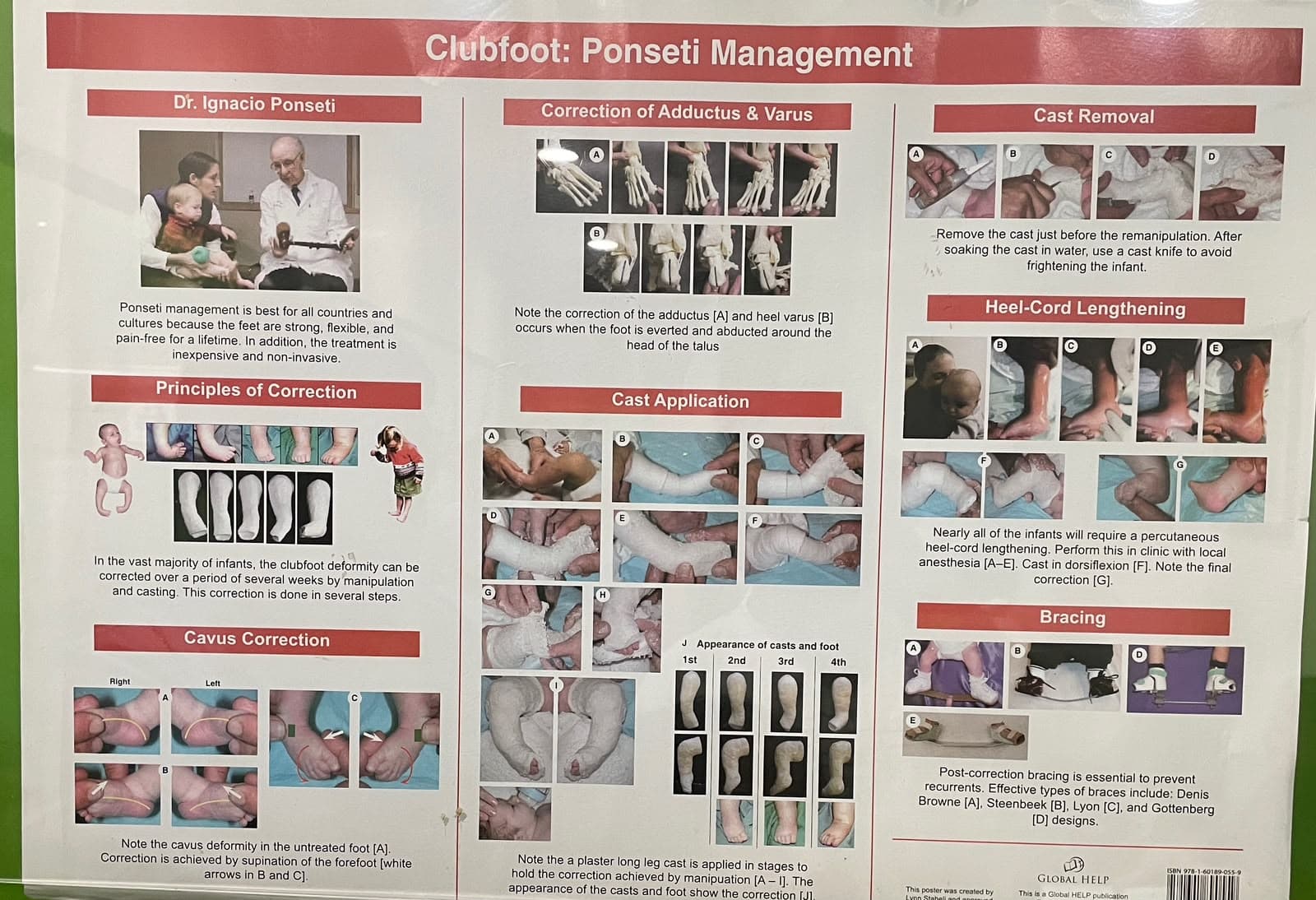
Clinical teaching visual
See the Ponseti treatment sequence
This clinical teaching poster shows the main elements of Ponseti management: gradual correction, serial casting, possible Achilles tenotomy and bracing.
The cast-removal and tenotomy panels are for clinicians. Whether a child needs tenotomy and how a cast is removed depend on the treating team.
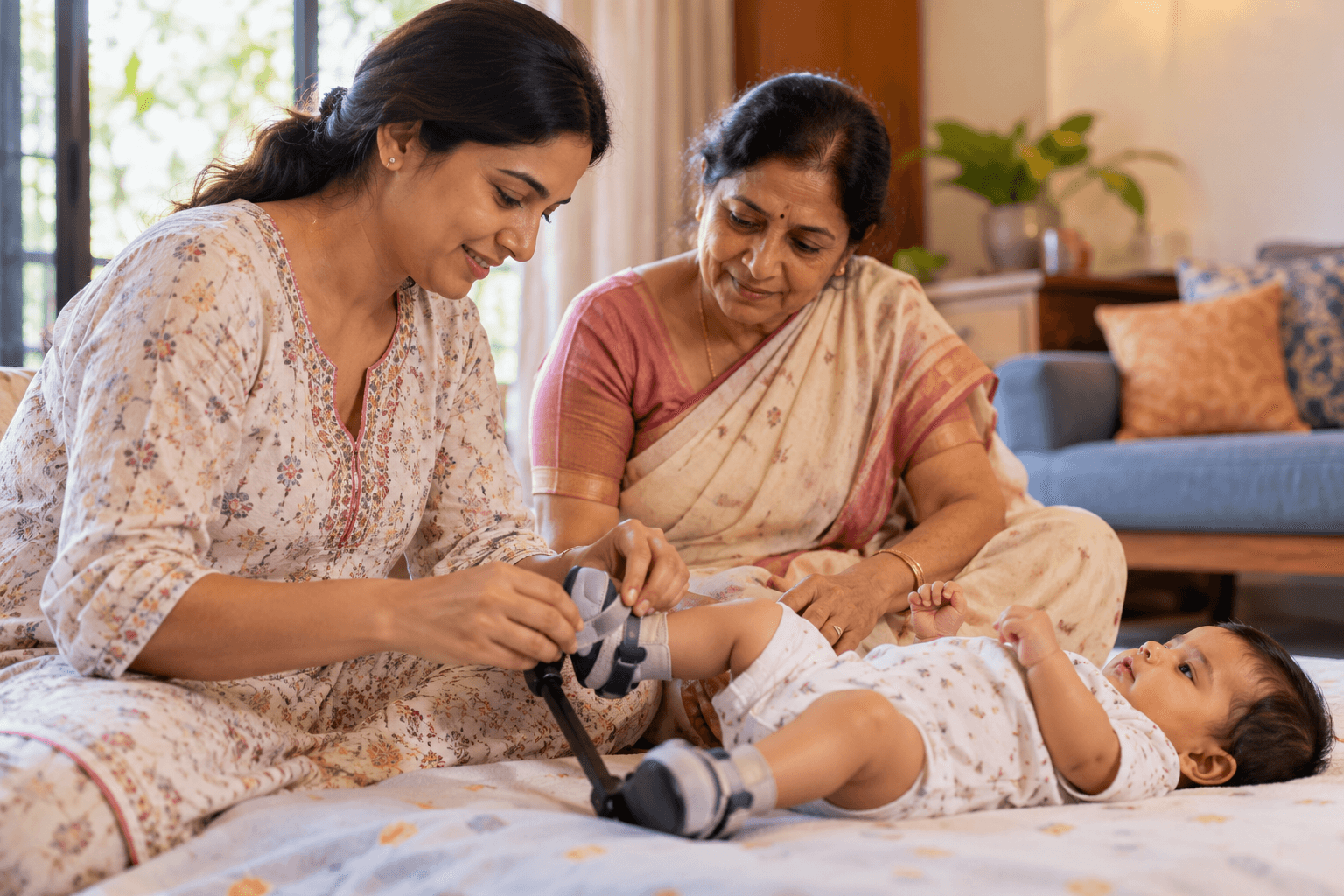
Why bracing receives so much emphasis
Clinical guidance consistently links poor brace adherence or stopping bracing early with a higher risk of recurrence. That is why Happy Feet treats bracing as a major part of the journey rather than a small final step.
Go to Bracing & Maintenance →What can vary by child
- How many casts are needed.
- Whether and when a tenotomy is recommended.
- Where the tenotomy is performed and which type of anaesthesia is used.
- The exact brace, fitting details and prescribed wear schedule.
- The length and frequency of follow-up.
- Treatment details for atypical, syndromic, neurogenic or later-presenting clubfoot.
For your next appointment
Questions to ask your treating team
- Who on the team is trained and experienced in the Ponseti method?
- How will you decide when casting is complete?
- How will you decide whether my child needs a tenotomy?
- When should the brace be ready, and who will fit it?
- What is my child’s prescribed brace plan?
- How often will you review the feet and brace during growth?
- Who should we contact if we are struggling with casting, the brace or appointments?
Sources
External clinical references and supplied material used for this guidance.
- American Academy of Pediatrics — Diagnosis and Treatment of Idiopathic Congenital Clubfoot (2022)
- Pediatric Orthopaedic Society of North America — Clubfoot Study Guide
- Ponseti International Association / University of Iowa — Bracing Tips
- CURE International India Trust
- Global HELP — Clubfoot: Ponseti Management poster
Supplied reference material
- Supplied Global HELP teaching poster photograph. The publisher's attribution is visible in the image; procedural panels are intended for trained clinical teams.
Journey overview
Current viewTreatment overview
Choose the stage you want to understand
The overview brings together casting, tenotomy if needed, and bracing. Treatment details and timing can vary for each child.
Was this helpful?
Your choice is only shown here during this visit. Feedback is not sent or saved.
Suggest a correction
You can copy a note for later. Please leave out names and personal health details.